Advocacy and Policymaker Pressures

The summer 2016 issue of Educational Leadership, published by ASCD, contains an article with useful guidelines for advocates seeking to influence policy at local, state, and national levels.

In “What It Takes to Get a Policymaker’s Attention,” Celine Coggins describes the three “central pressures” that influence policymaker thinking: promoting equity, allocating scarce resources, and addressing accountability issues.

  • Promoting equity: “Policymakers address equity at the system level,” Dr. Coggins writes. “Any policymaker whom you approach … will want to know how [your idea or program] creates more equity of opportunity.”
  • Allocating resources: “Policymakers must make hard tradeoffs with limited tax dollars,” Dr. Coggins observes. You must show them how your idea, activity, or program will have a greater positive effect and reach more people than other, equally worthy ones—or how it will address multiple areas of need by bringing multiple solutions together.
  • Addressing accountability: As public servants, policymakers must be able to demonstrate that they have been responsible stewards of the public interest. In other words, they must hold funded activities and programs accountable for their outcomes, and they can do this best when they have numbers. Advocates can use numbers to their advantage when they think beyond the usual data categories of testing outcomes and persons served and look to effects in the larger community.

Dr. Coggins writes, “Successful advocates will get policymakers on their side when they can show how their … proposals attend to these pressures.”

While the article is written for educators in K-12 contexts, its content has much value for practitioners in the broader education and social service communities. The article is available for free at https://www.ascd.org/el/articles/what-it-takes-to-get-a-policymakers-attention

The Divide Isn’t Just Digital

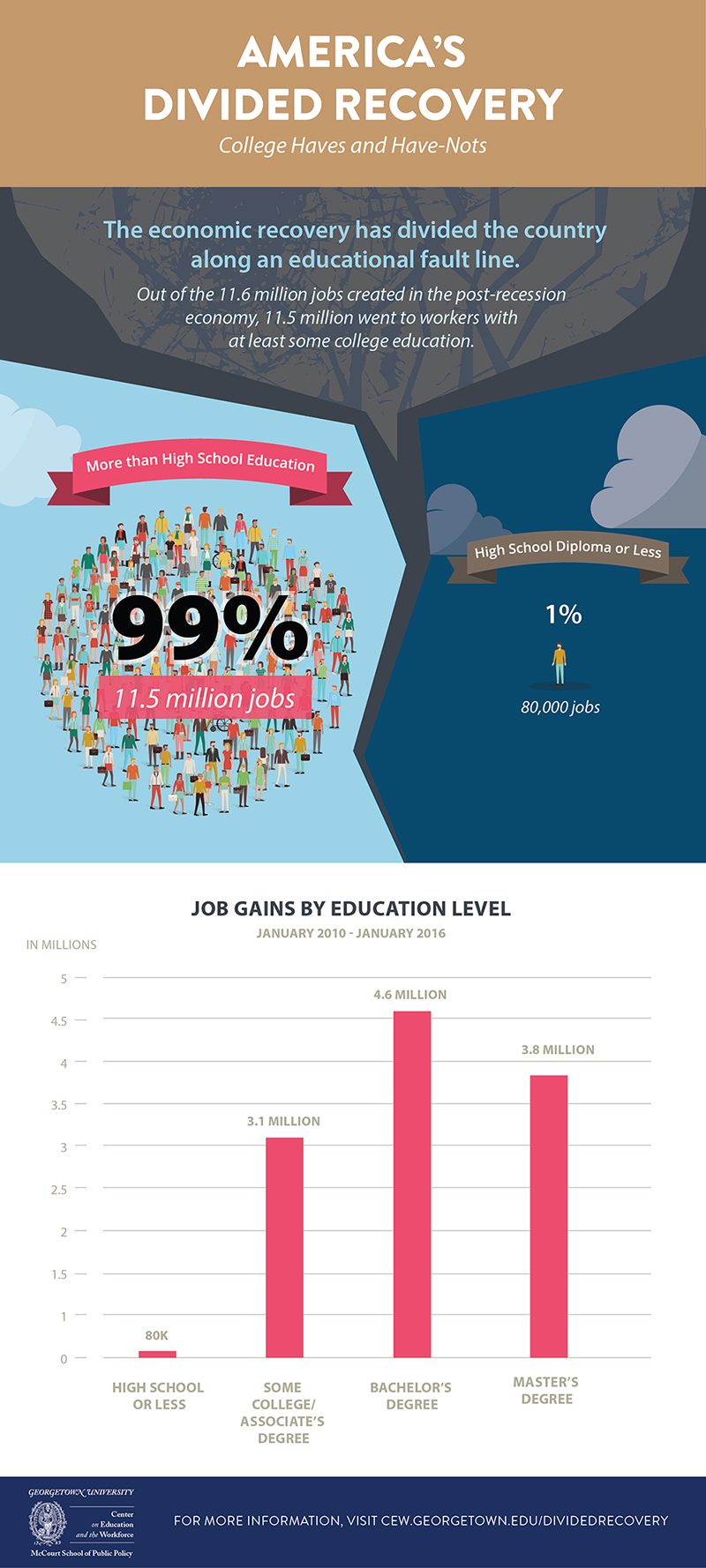
A powerful infographic on the divide between those who have attended college and those who have not, from the Center on Education and the Workforce at Georgetown University.

“Out of the 11.6 million jobs created in the post-recession economy, 11.5 million went to workers with at least some college education.”

https://cew.georgetown.edu/wp-content/uploads/DR-infographics-1.pdf#zoom=250

DR-infographics-1

A Resolution That Sees Beyond the Self

In her January 14 column, Lonnae O’Neal suggests that, for this new year, we resolve to be mindful of others — and act on that awareness consistently, responsibly, and respectfully.

Must the poor lose privacy before we give?

by Lonnae O’Neal, wapo.st/lonnae

I had never heard the term “poverty porn” — the idea of using stories and images to tug at our heartstrings so we open our wallets — until this week. But I certainly knew it when I saw it. It’s rampant around the holidays.

It’s the story of the inner-city family shivering in a one-room apartment with no heat. Or the photo of a tattered rural teen who cares for a half-dozen younger siblings while her mother works overnight.

It’s the idea that “we have to trot out the stories of needy people,” in detail, for people to make donations, says Shay Stewart-Bouley, executive director of Boston’s Community Change, which combats racism. And the way we do it “doesn’t feel respectful to their humanity. . . . We should probably ask ourselves, ‘Why do we need to see that in order to give?’ ”

For two decades, Stewart-Bouley has worked for nonprofit entities that help underserved communities. She wonders why people do not think of giving year-round, something the nonprofits do as a matter of being part of a community. Then they would not need manipulative videos that invade privacy — that zoom close in on pain, distress and privation — in the name of helping out.

Charitable donations and volunteering drop off dramatically in January, and “by June or July, everybody is on vacation,” says Stewart-Bouley. But people need to eat every day.

Small organizations that fall outside urban areas are often especially underfunded, and Stewart-Bouley calls January a good time for the civic-minded to think not just about money but also about time and skills that might help a small organization — volunteering one’s social media prowess, delivering food, answering phones.

Michele Booth Cole is executive director of Safe Shores — the DC Children’s Advocacy Center, which serves families affected by violence. Each year, the center makes a holiday plea to donors, who are matched with a wish list that gives children’s ages, gender and what they want for Christmas. The center does not provide names or any identifying features of the recipient families out of respect for their privacy and to honor their dignity. Donors fill the lists and drop off presents.

“There were literally thousands of gifts — doll­houses, bicycles. Somebody gave an iPad to one family. People were just incredibly generous,” Cole says. “Then it’s January.”

And the donor numbers drop off to just a fraction of what they were in December. Maybe 25 people a month seek to donate instead of 250. The number does not rise again until the following December, Cole says. “One of the things we talk about all the time is that child abuse doesn’t just happen in December or during back-to-school month.”

Studies show that donors feel an emotional lift when they give. And when giving or volunteering is done outside the holiday rush, people have a chance to be thoughtful about how they want to sustain and interact with their communities. “You can find out what moves you,” Cole says. “We have [coffees and tours] where you can come in and learn what we do.”

We want people “who care about our cause to invest, then tell friends and family and co-workers,” she says. “That’s how you build a movement.”

While we’re hopeful about all the other things we want to change for the new year — like our waistlines and savings — we might also think about our responsibilities to one another.

Cole says we need to shift “the cadence of the conversation” so that giving is a part of the culture. And it at least needs to outlast our other resolutions.

Published in the Washington Post, 14 January 2016
The Power of Singing, part 2


Here is an update from Colby Itkowitz on the Atlanta Homeward Choir’s trip to Washington, DC, where they sang at the Lincoln Memorial and at the White House. Itkowitz writes: “Suddenly these men, who for most of their days feel invisible, were seen.”

Homeless singers achieve their dream by singing at White House, Lincoln Memorial

At the Lincoln Memorial the men performed Leonard Cohen’s Hallelujah. Its lyrics end this way:

I did my best, it wasn’t much
I couldn’t feel, so I tried to touch
I’ve told the truth, I didn’t come to fool you
And even though
It all went wrong
I’ll stand before the Lord of Song
With nothing on my tongue but Hallelujah

The Power of Singing

“It fosters a strong sense of community and a sense of hope … a sense of a life beyond where I am now.”

An inspiring day-after-Thanksgiving story about the Atlanta Homeward Choir by Colby Itkowitz of the Washington Post.

A carol from the homeless: Atlanta shelter’s choir to sing at White House


Why Adult Basic Education Matters

Minnesota Adult Basic Education has a YouTube channel where they are posting a series of Hot Ideas videos on Why ABE Matters. In the six 30-minute videos, adult ed professionals give TED-Talk-like presentations based in their experience working with adults who are developing literacy and English language skills. The videos are informative and powerful — definitely worth watching.

The videos all build on the fundamental understanding expressed by Jodi Versaw: “I believe ABE matters because education is a human right.”

View the videos on the MN ABE YouTube channel

(Re) Introducing Key Words

Friends and colleagues, after a great ten-year run at the Center for Applied Linguistics, I am moving on to new challenges and new adventures. Over the summer I will be transitioning from staff to consultant status, and by autumn I will once again be working for myself. I’ll be doing business under the name Key Words, which I used in my previous successful stint as a consultant (1998-2005). I invite you to follow me as my business and I grow into this encore phase of my career.